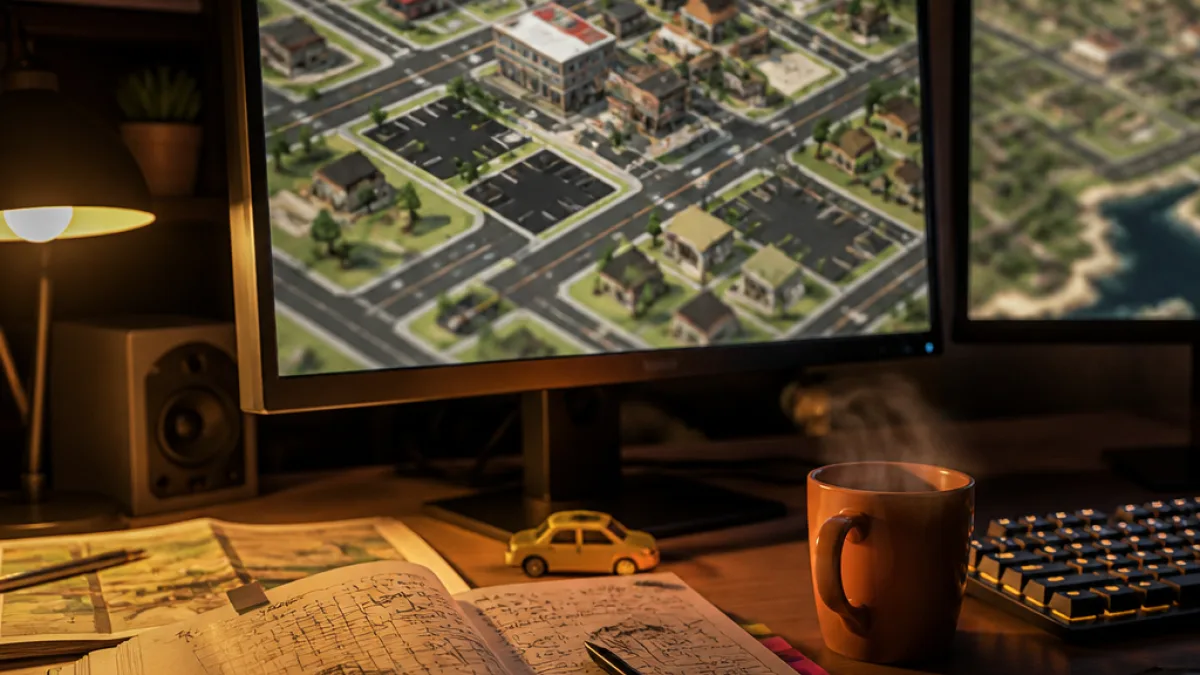
Car Park Capital has entered early access as a management sim that asks players to build profit by paving over public goods and expanding suburban sprawl. The game intentionally echoes the look and systems of classic ’90s simulation titles while using its mechanics to lampoon automobile-first urban planning.
Design and tone
PC Gamer’s writer framed the game as both satire and simulation. Players control land purchases and redevelopment, buying up parcels of existing urban fabric—dense housing blocks, public transport hubs and green spaces—and replacing them with paid parking and low-density suburbs. An on-screen mascot, an anthropomorphic steering wheel, reinforces the game’s tongue-in-cheek celebration of car-centred development.
- Aesthetic: The game intentionally recreates the blocky, polygonal, sprite-driven visuals of late-1990s management sims, evoking titles like Theme Park and RollerCoaster Tycoon.
- Systems: Gameplay centers on land acquisition, demolition, and the construction of parking and suburban housing, with secondary systems addressing crime, transport, and displaced residents.
- Tone: PC Gamer describes the title as satirical, making its critique of car dependency explicit through both mechanics and UI elements.
Gameplay examples cited
As players buy and bulldoze downtown apartment blocks, the displaced residents require housing. The game provides a solution in the form of sprawling, automobile-dependent suburbs with limited transport options—an outcome the developer presents as profitable within the simulation. The writer emphasized how the game rewards decisions that degrade walkability and public transport while expanding asphalt and parking.
PC Gamer also noted that the title does not simply imitate older sims: it expands the simulation scope to include social consequences of redevelopment decisions, such as eviction and urban displacement, folded into the economic systems the player manipulates.
Context
Car Park Capital joins a recent wave of management and citybuilding sims that revisit classic mechanics and aesthetics while examining contemporary urban issues. The PC Gamer piece frames the game as both nostalgic and pointed, using its systems to stage a critique of suburbanization and car-first policy.
The game is currently available in early access, where players can experience its systems and provide feedback as development continues.