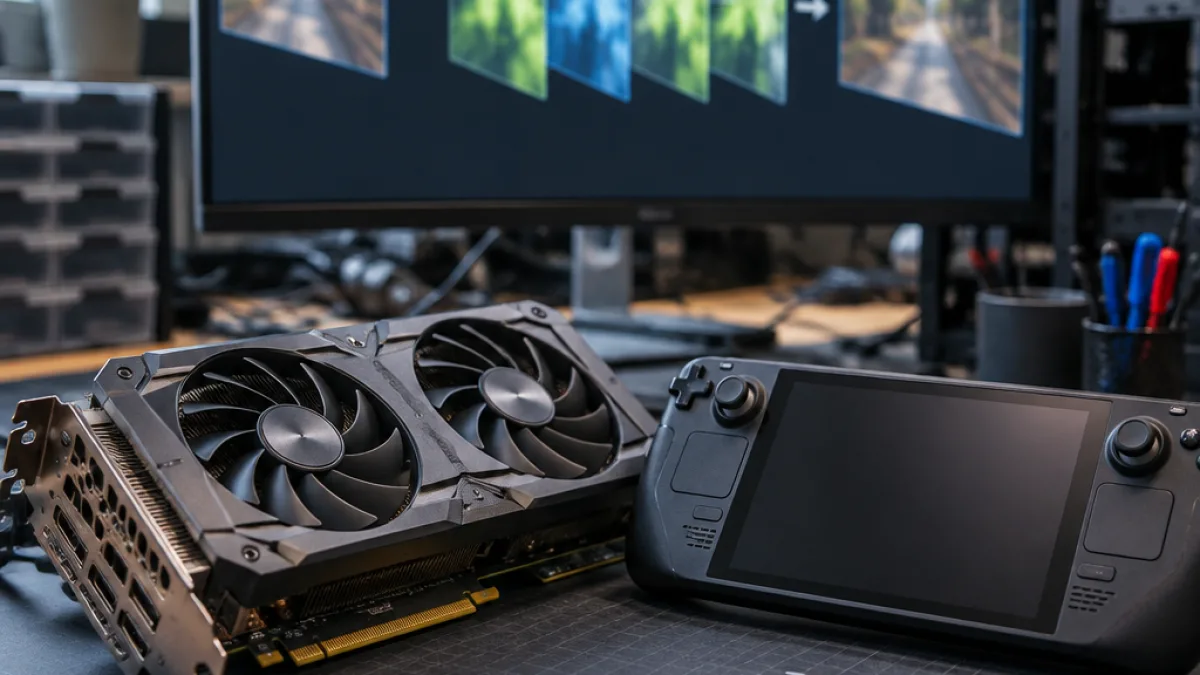
Apex Compute has released a beta version of its Apex Neural Rendering frame-generation technology, bringing an alternative to NVIDIA’s DLSS Frame Generation to a wider range of PC graphics hardware. The beta is distributed through OptiScaler and supports GeForce GTX 16-series and Radeon RX 5000-series GPUs, Intel Arc cards and the Steam Deck.
The compatibility list is the central detail for hardware that cannot use newer versions of NVIDIA’s frame-generation technology. Apex Neural Rendering is also designed as part of a larger rendering suite that includes super resolution and ray reconstruction, but Apex has only marked frame generation as a beta feature.
Apex’s RTX 5090 comparison
Apex published its main comparison using an NVIDIA GeForce RTX 5090 rendering at 3,840 × 2,160. In the 2X mode, the company measured Apex Neural Rendering at 1.01 milliseconds for each generated frame, compared with 1.26 milliseconds for DLSS Frame Generation. Those measurements cover the frame-generation operation itself rather than total game performance or latency between a controller input and the image appearing on screen.
The company’s 4X test showed the same ordering. Apex measured 0.61 milliseconds per generated frame for Apex Neural Rendering, compared with 0.82 milliseconds for DLSS Frame Generation. It also listed a lower memory requirement for the Apex system in that comparison:
- 214MB of GPU memory for Apex Neural Rendering
- 562MB of GPU memory for DLSS Frame Generation
- 0.17MB for Apex Neural Rendering’s network weights
The network-weight figure refers to the model weights and is separate from the full GPU-memory measurement. Apex’s published results are the company’s own tests, rather than independent benchmark results.
Image-quality tests and game captures
Apex also reported results for the CGVQM-5, ColorVideoVDP and PSNR image-quality measures across its 2X through 6X modes. Apex Neural Rendering scored ahead of DLSS in each comparison listed on the company’s page. The testing material includes synthetic scenes and captures from The Last of Us Part II, focusing on visual differences involving moving objects, vegetation and water.
Some of the game comparisons identify NVIDIA SDK 310.9.16 as the DLSS reference version. The published demonstrations are intended to show the differences between the two frame-generation systems, while the beta status means Apex Neural Rendering remains an in-development release. The beta’s distribution through OptiScaler provides the stated path for testing it on the supported GeForce, Radeon, Intel Arc and Steam Deck hardware.